
Permian Basin Investment Opportunities: The Case for America's Most Productive Oil Basin
We focus exclusively on the Permian Basin. Not because it's convenient — we're based in Texas — but because it is, by every metric that matters to direct investors, the most favorable operating environment for domestic oil production in the world. This page explains why, what the geological advantage actually means for your investment, and how the Permian compares to other domestic plays we evaluated before committing to it as our primary basin.
Request Your Program OverviewThe Geological Advantage: Stacked Pay Zones
The Permian Basin spans 86,000 square miles across West Texas and southeastern New Mexico. It accounts for approximately 45% of total U.S. crude oil production as of 2025. The EIA projects Permian output to reach 6.6 million barrels per day in 2026.
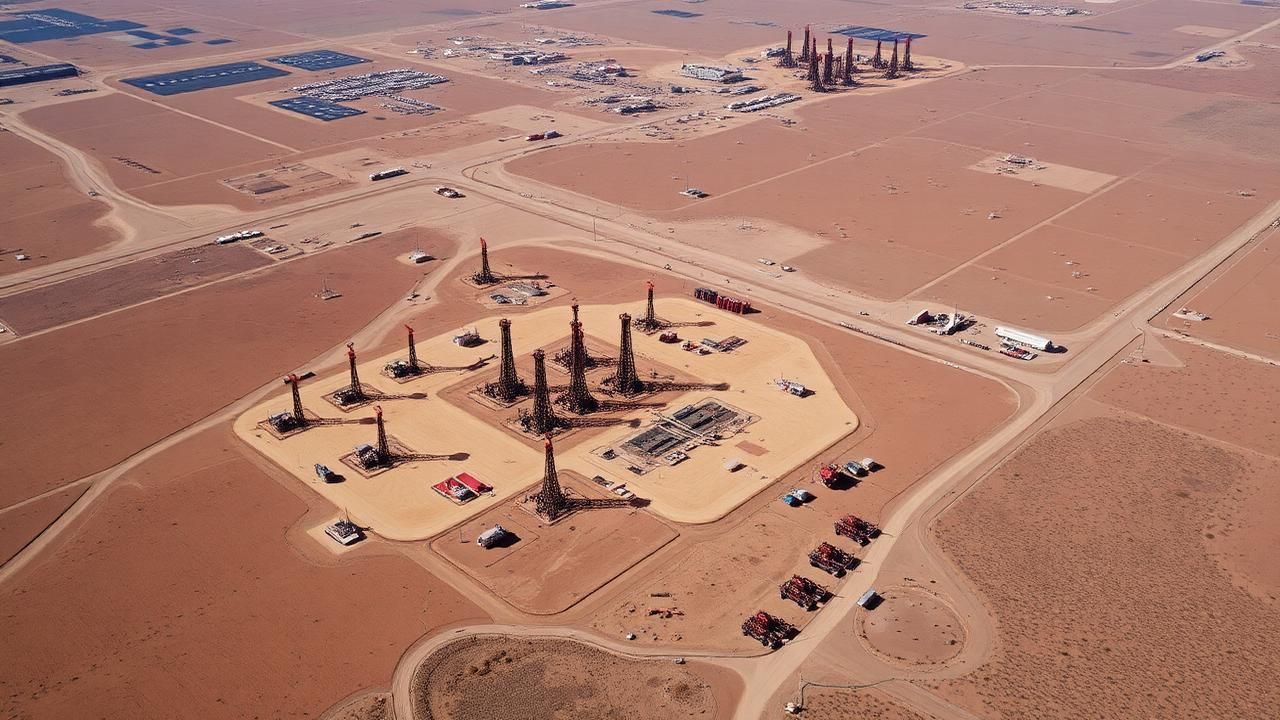
The single most important geological feature of the Permian Basin for investors is the stacked pay column. Unlike single-formation plays — the Bakken in North Dakota targets primarily the Bakken and Three Forks formations; the Haynesville in Louisiana targets primarily one formation — the Permian Basin contains 4–8 distinct productive formations at different depths beneath the same surface acreage.
In the Midland Basin, an operator drilling from a single surface pad may access the Wolfcamp A, Wolfcamp B, Wolfcamp C, Spraberry, Dean, and Bone Spring formations — each with independently documented production histories, each at a different depth, each requiring a separate horizontal lateral to develop.
- Capital efficiency: One surface location — one road, one water line, one electrical connection, one saltwater disposal hookup — can be used to develop multiple formations. Shared infrastructure reduces per-well cost.
- Geological redundancy: If one formation underperforms in a specific area, adjacent zones may perform at or above type curve expectations. Single-zone plays have no such redundancy.
- Development inventory: An operator with Permian acreage has years — sometimes decades — of identifiable drilling locations across multiple formations. Permian programs aren't one-and-done; they're long-term development campaigns.
- Production documentation: Hundreds of thousands of wells have been drilled in the Permian Basin across all major formations. Production data from nearby offset wells provides more reliable pre-drill estimates than any frontier or emerging play.
Midland Basin vs Delaware Basin: What the Sub-Basin Difference Means
| Factor | Midland Basin | Delaware Basin |
|---|---|---|
| Location | Eastern Permian — Midland TX area | Western Permian — Reeves, Loving, Ward counties |
| Key formations | Wolfcamp, Spraberry, Dean | Bone Spring, Wolfcamp, Delaware, Avalon |
| Development stage | More mature — extensive offset production data | Active expansion — newer development areas |
| Infrastructure | Highly developed — lower midstream cost | Expanding — some areas still building out |
| Geological risk | Lower — well understood formations | Moderate — some zones still delineating |
Illustrative example only. Actual tax savings and investment returns depend on individual circumstances including tax bracket, AMT exposure, state tax treatment, program structure, and well performance. Not a projection or guarantee of results. Consult a qualified CPA before making any investment decision.
The Texas Railroad Commission: Your Due Diligence Tool
Before you invest in any of our programs, you can look up the operator's production history yourself. Search the operator's name. Filter by county and formation. Pull monthly production volumes for every well they've drilled in the Permian Basin over the past 10 years. Compare what you find to what the PPM claims. If an operator's actual RRC production history matches their marketing materials, that's a positive signal. If it doesn't, you haven't invested yet. See invest in Texas oil wells for the full due diligence checklist.
- Go to rrc.texas.gov and click 'Data & Statistics'
- Select 'Production Data Query System' from the menu
- Search by operator name — this returns all wells the operator has drilled in Texas
- Filter by county (e.g., Midland, Martin, Glasscock) and formation for relevant comparison
- Review monthly production history — look for consistency and decline curve behavior
- Cross-reference with the program's independent reserve report
- Check the operator's compliance history for any RRC enforcement actions
Infrastructure Advantages That Lower Your Operating Costs
- Pipeline connectivity: The Permian Basin has more crude oil and natural gas pipeline miles than any other U.S. producing region. Wells connect to takeaway infrastructure quickly, reducing flaring and basis risk. Your oil moves to market at competitive prices.
- Saltwater disposal networks: Produced water disposal is one of the largest operating costs in mature oil wells. The Permian's established SWD infrastructure and competitive disposal market keeps per-barrel disposal costs lower than in emerging plays.
- Oilfield services density: Hundreds of drilling contractors, completion companies, wireline firms, and field service providers operate in the Permian Basin. That competition keeps service costs lower and mobilization times faster.
- Natural gas processing: Permian wells produce associated natural gas alongside crude oil. Established processing plants capture NGLs (natural gas liquids) that generate additional revenue beyond crude. In basins without processing infrastructure, this value is often flared or stranded.
Why We Don't Operate in Other Basins
None of these are bad places to drill. But for accredited investors whose primary interest is combining first-year tax efficiency with the most geologically de-risked domestic production environment available, the Permian Basin wins every comparison we ran. That's why we're here. See our oil & gas tax deductions guide and accredited investor programs.
Frequently Asked Questions
What are the best Permian Basin investment opportunities for accredited investors?
+
How do I evaluate a Permian Basin investment program?
+
What is the Wolfcamp formation and why is it the primary target?
+
What is the minimum investment for Permian Basin programs?
+
How do Permian Basin investment opportunities compare to 3 years ago?
+
Why the Permian Basin Has Survived Every Commodity Price Cycle
Wolfcamp Formation Specifics: What Drives Investor Economics
How Texas Oil Investments Facilitates Access to Permian Basin Programs
The information on this page is for educational purposes only and does not constitute investment advice, tax advice, or legal advice. Oil and gas working interest investments involve significant risks including commodity price volatility, geological risk, operational risk, and potential loss of entire invested capital. All tax benefit descriptions reference IRC provisions as currently in effect; tax law is subject to change and individual tax treatment varies. All dollar examples and projections are illustrative only — not representations of actual returns. Programs are offered exclusively to verified accredited investors as defined by SEC Rule 501, under SEC Regulation D Rule 506(b). This page does not constitute an offer to sell or solicitation of an offer to buy any security. Consult a qualified CPA, attorney, and financial advisor before making any investment decision.
Request Your Program Overview
Complete this 60-second form to receive our current investment program details.
By requesting information, you represent that you believe you qualify as an accredited investor as defined by SEC Rule 501. This is not an offer to sell or solicitation to buy any security. Programs available only to verified accredited investors under SEC Regulation D Rule 506(b). No obligation to invest.
Accredited Investors Only · No Obligation
Discover If You Qualify for Our Current Program
Complete our 60-second investor questionnaire to receive our program overview.
Request Your Program OverviewBy requesting information, you represent that you believe you qualify as an accredited investor as defined by SEC Rule 501. This is not an offer to sell or solicitation to buy any security. Programs available only to verified accredited investors under SEC Regulation D Rule 506(b). No obligation to invest.